Tell your friends about this item:
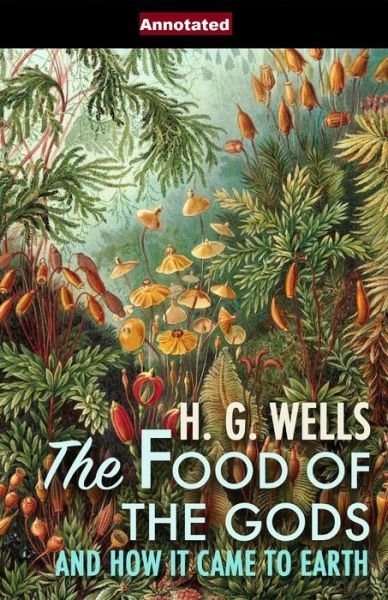
The Food of the Gods and How It Came to Earth H G Wells
Our customers say:


Also available as:
- Paperback Book (2017) Íkr 1,809
- Paperback Book (2015) Íkr 2,129
- Paperback Book (2016) Íkr 2,139
- Paperback Book (2011) Íkr 2,159
- Paperback Book (2018) Íkr 2,199
- Paperback Book (2017) Íkr 2,309
- Paperback Book (2015) Íkr 2,319
- Paperback Book (2017) Íkr 2,349
- Paperback Book (2017) Íkr 2,379
- Paperback Book (2017) Íkr 2,529
- Paperback Book (2018) Íkr 2,749
- Paperback Book (2015) Íkr 2,989
- Paperback Book (2017) Íkr 3,199
- Hardcover Book (2020) Íkr 3,469
- Paperback Book (2014) Íkr 3,969
The Food of the Gods and How It Came to Earth
H G Wells
begins with satirical remarks on "scientists," then introduces Mr. Bensington, a research chemist specialising in "the More Toxic Alkaloids," and Professor Redwood, who after studying reaction times takes an interest in "Growth." Redwood's suggestion "that the process of growth probably demanded the presence of a considerable quantity of some necessary substance in the blood that was only formed very slowly" causes Bensington to begin searching for such a substance. After a year of research and experiment, he finds a way to make what he calls in his initial enthusiasm "the Food of the Gods," but later more soberly dubs Herakleophorbia IV. Their first experimental success is with chickens that grow to about six times their normal size on an experimental farm at Hickleybrow, near Urshot in Kent . Herbert George Wells, better known as H. G. Wells, was an English writer best known for such science fiction novels as The Time Machine, The War of the Worlds and The Invisible Man. He was a prolific writer of both fiction and non-fiction, and produced works in many different genres, including contemporary novels, history, and social commentary. Wells was an outspoken socialist and a pacifist, and his later works became increasingly political and didactic. His middle period novels (1900-1920) were more realistic; they covered lower middle class life and the 'New Woman' and the Suffragettes. Along with Jules Verne, Well is often referred to as "The Father of Science Fiction".
| Media | Books Paperback Book (Book with soft cover and glued back) |
| Released | February 1, 2020 |
| ISBN13 | 9798605780298 |
| Pages | 750 |
| Dimensions | 152 × 229 × 42 mm · 1.08 kg |
| Language | English |
![Cover for H G Wells · Тоно Бунгей; Tono Bungay (Paperback Book) [Russian edition] (2026)](https://imusic.b-cdn.net/images/item/original/359/9781715674359.jpg?h-g-wells-2026-n-tono-bungay-paperback-book&class=scaled&v=1647826267)