
Tell your friends about this item:
Walden Henry David Thoreau
Our customers say:


Also available as:
- Book (2004) Íkr 1,549
- Paperback Book (2017) Íkr 1,659
- Paperback Book (2015) Íkr 1,779
- Paperback Book (2018) Íkr 1,779
- Paperback Book (2017) Íkr 1,829
- Paperback Book (2014) Íkr 1,849
- Paperback Book (2018) Íkr 1,849
- Paperback Book (2017) Íkr 1,849
- Paperback Book (2017) Íkr 1,889
- Paperback Book (2010) Íkr 1,939
- Paperback Book (2019) Íkr 1,939
- Paperback Book (2016) Íkr 1,949
- Paperback Book (2018) Íkr 1,949
-
Paperback BookChump Change edition(1901) Íkr 1,989
- Paperback Book (2014) Íkr 2,049
- Paperback Book (2018) Íkr 2,049
- Paperback Book (2016) Íkr 2,049
- Paperback Book (2017) Íkr 2,089
- Paperback Book (2016) Íkr 2,109
- Paperback Book (2011) Íkr 2,149
- Paperback Book (2023) Íkr 2,149
- Paperback Book (2010) Íkr 2,149
- Paperback Book (2018) Íkr 2,169
- Paperback Book (2018) Íkr 2,189
- Paperback Book (2014) Íkr 2,209
Walden
Henry David Thoreau
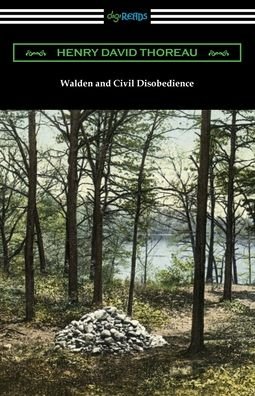
Part memoir and part spiritual quest, Walden opens with the announcement that Thoreau spent two years at Walden Pond living a simple life without support of any kind. Readers are reminded that at the time of publication, Thoreau is back to living among the civilized again. The book is separated into specific chapters, each of which focuses on specific themes: Economy: In this first and longest chapter, Thoreau outlines his project: a two-year, two-month, and two-day stay at a cozy, "tightly shingled and plastered", English-style 10' × 15' cottage in the woods near Walden Pond.[4] He does this, he says, to illustrate the spiritual benefits of a simplified lifestyle. He easily supplies the four necessities of life (food, shelter, clothing, and fuel) with the help of family and friends, particularly his mother, his best friend, and Mr. and Mrs. Ralph Waldo Emerson. The latter provided Thoreau with a work exchange -- he could build a small house and plant a garden if he cleared some land on the woodlot and did other chores while there.[4] Thoreau meticulously records his expenditures and earnings, demonstrating his understanding of "economy", as he builds his house and buys and grows food. For a home and freedom, he spent a mere $28.121/2, in 1845 (about $934 in 2018 dollars). At the end of this chapter, Thoreau inserts a poem, "The Pretensions of Poverty", by seventeenth-century English poet Thomas Carew. The poem criticizes those who think that their poverty gives them unearned moral and intellectual superiority. Much attention is devoted to the skepticism and wonderment with which townspeople greeted both him and his project as he tries to protect his views from those of the townspeople who seem to view society as the only place to live. He recounts the reasons for his move to Walden Pond along with detailed steps back to the construction of his new home (methods, support, etc.).
| Media | Books Paperback Book (Book with soft cover and glued back) |
| Released | March 1, 2020 |
| ISBN13 | 9798619505689 |
| Publishers | Independently Published |
| Pages | 376 |
| Dimensions | 152 × 229 × 21 mm · 548 g |
| Language | English |
More by Henry David Thoreau
Show all























More from this series




![Cover for Henry David Thoreau · Walden (Collector's Edition) (Laminated Hardback with Jacket) (Hardcover Book) [Collector's edition] (2024)](https://imusic.b-cdn.net/images/item/original/842/9781998621842.jpg?henry-david-thoreau-2024-walden-collector-s-edition-laminated-hardback-with-jacket-hardcover-book&class=scaled&v=1733763751)



![Cover for Henry David Thoreau · Walden (Royal Collector's Edition) (Case Laminate Hardcover with Jacket) (Hardcover Book) [Royal Collector's edition] (2020)](https://imusic.b-cdn.net/images/item/original/465/9781774378465.jpg?henry-david-thoreau-2020-walden-royal-collector-s-edition-case-laminate-hardcover-with-jacket-hardcover-book&class=scaled&v=1647973934)


![Cover for Henry David Thoreau · Walden - Macmillan Collector's Library (Hardcover Book) [New edition] (2016)](https://imusic.b-cdn.net/images/item/original/704/9781509826704.jpg?henry-david-thoreau-2016-walden-macmillan-collector-s-library-hardcover-book&class=scaled&v=1475426773)


![Cover for Henry David Thoreau · Walden / Civil Disobedience / and Other Writings: A Norton Critical Edition - Norton Critical Editions (Paperback Book) [Third edition] (2008)](https://imusic.b-cdn.net/images/item/original/900/9780393930900.jpg?henry-david-thoreau-2008-walden-civil-disobedience-and-other-writings-a-norton-critical-edition-norton-critical-editions-paperback-book&class=scaled&v=1463574763)

![Cover for Henry David Thoreau · Walden and Civil Disobedience (Paperback Book) [Reissue edition] (2012)](https://imusic.b-cdn.net/images/item/original/169/9780451532169.jpg?henry-david-thoreau-2012-walden-and-civil-disobedience-paperback-book&class=scaled&v=1410013814)




![Cover for Henry David Thoreau · Walden and Civil Disobedience (Paperback Book) [Canon Classics Worldview edition] (2019)](https://imusic.b-cdn.net/images/item/original/567/9781944503567.jpg?henry-david-thoreau-2019-walden-and-civil-disobedience-paperback-book&class=scaled&v=1644241519)


![Cover for Henry David Thoreau · Walden and Civil Disobedience - Enriched Classics (Paperback Book) [Enriched Classic edition] (2004)](https://imusic.b-cdn.net/images/item/original/726/9780743487726.jpg?henry-david-thoreau-2004-walden-and-civil-disobedience-enriched-classics-paperback-book&class=scaled&v=1416170443)



See all of Henry David Thoreau ( e.g. Paperback Book , Hardcover Book , Book , CD and MP3-CD )